What is
The difference between all-on-4 and all-on-6?
In order to be able to fit an all-on-4 system to a patient, the patient’s jawbone must be in good condition. If the patient has jaw atrophy, then it is better to choose the all-on-6 system, since due to the greater number of supports, the structure will be more firmly fixed.
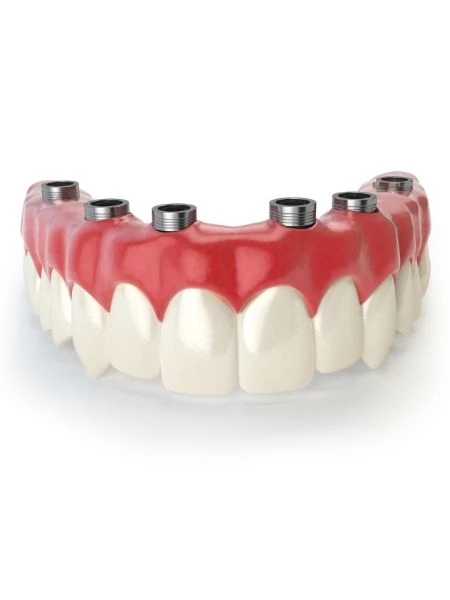
When installing all-on-6 there are more anchor points, this allows us to make a prosthesis without gingival mass. If a person has been wearing removable dentures for a long time, or has serious jaw defects, then all-on-6 will not suit such a patient.
Read more about the all-on-4 methodology in our page.
All-on-6 implants?
All-on-six implantation is designed for the rehabilitation of patients with an edentulous jaw without osteoplasty. At the initial and middle stages of mandibular bone resorption, lateral implants are implanted at an angle into areas with an acceptable bone volume remaining. With a critical decrease in the bone tissue of the upper jaw, zygomatic implants are used.
All-on-6 implantation involves the installation of 2 implants vertically in the anterior jaw in the zone of the central incisors, 2 implants are implanted in the lateral areas of the jaw arch, 2 more implants are implanted in an inclined position. The angle of inclination is selected depending on the state of the bone, the degree of rarefaction of the spongy layer of the jaw and other important factors.
Titanium pins are
İntegrated in the same way
as with all-on-4 the difference is that in the distal (lateral) sections of the jaw, 1 more implant is added on each side.
With all-on-6 implantation, chewing pressure is distributed evenly, the system is not overloaded and its reliability is increased.
Dental implant surgery performed?
Our biggest goal is for you to return to your country happily with a beautiful smile from our clinic.
Dental implant surgery is performed under local anaesthesia. A small incision is made in the gums, the titanium post is inserted into the jawbone, and the gums are stitched. This operation takes about 30 minutes. In the following stages, the artificial tooth is placed on the post.
For lateral implants, special multi-unit abutments are used, which allow us to install the crown strictly vertically, regardless of the angle of the pin.
The design, installed according to the all-on-6 method, restores the aesthetic contour of the gums and withstands a full chewing load. The all-on-6 method involves the use of pins with a special coating that stimulates bone tissue regeneration. Due to this, the survival rate of new teeth on 6 implants is high.
The all-on-6 concept refers to a one-stage implantation protocol, i.e. a temporary prosthesis can be installed on the day of surgery or 3 days after it.
You may be interested in the all-on-6 implant procedure if:
1. You have a complete adentia of the jaw, in which some parts of the jawbone have strongly atrophied, that is, they have lost their original volume.
2. You have a partially edentulous jaw, that is, your remaining teeth are very loose and are not suitable as supports for a classic bridge.
3. You have periodontitis or periodontal disease.
4. You have involuntary teeth grinding.
5. You have been diagnosed with moderate to high bone resorption.
6. You have some peculiarities of bite, in which you are shown the installation of an orthopedic structure with 14 artificial teeth.
As for other clinical cases, all-on-4 can also handle them.
You can consult about the most suitable implant placement method for you in our clinic.
How to
Care for your new all-on-6 teeth?
Special attention should be paid to nutrition. Dishes can be familiar, but crushed or grated. Gradually, more solid foods can be introduced into the diet. After complete engraftment, you can eat solid food.
The most important thing in the presence of implants is high-quality oral hygiene: in the morning, in the evening and after each meal, it is recommended to clean the implants with a regular toothbrush (preferably soft or medium hardness) and toothpaste. In the first week it is necessary to rinse your mouth with chlorhexidine and then use the irrigator in the morning and evening on an ongoing basis.
Toothpaste in this case should contain a minimum of abrasive substances and should not contain calcium and fluoride.
Six months after the operation, and then once a year, you need to professionally clean the prosthesis in dentistry.
Professional dental cleanings should be carried out regularly and only by those specialists who have the appropriate experience in hygiene in the presence of dental implants.